Hearthstone
The Way of KingsHearthstone is Kaladin’s formative hometown, a place defined by intimate medical work, inherited social roles, and the arrival of a new citylord who brings the hierarchy of Alethkar into immediate view. It is both a refuge of practical care and the confined “ordinary world” from which Kaladin begins imagining a life beyond his father’s profession, his town, and the limits imposed by birth.
Definition and Setting
Hearthstone appears first as a close, materially specific community rather than an abstract backdrop. In the family’s operating room, the windows are shuttered against the darkness and the only dependable illumination comes from Stormlight held in a large globe filled with spheres. The globe contains an extraordinary sum of broams, kept on permanent loan from Hearthstone’s landlord. Lanterns flicker, but Stormlight remains steady, and Lirin treats that reliability as something capable of saving lives. The town’s resources are therefore bound to local authority even in the most private act of healing: medicine depends on light that belongs, indirectly, to the landlord.
The same scene presents Hearthstone as a place where care is immediate and imperfect. Lirin secures a wounded young woman, Sani, to a narrow operating table while Kaladin assists him. Sani is fifteen, drugged, and suffering from a badly bandaged injury to her freehand; the cloth appears to have been torn from a shirt and tied around the wound in haste. The operating room is not a polished hospital but a pressured household practice in which family members, limited equipment, and borrowed illumination must be assembled quickly around a vulnerable patient.
Medicine and Family Obligation
Hearthstone is central to Kaladin’s early relationship with medicine. He worries whenever someone is wounded, and his anxiety over Sani is presented as a recurring moral instinct rather than mere professional training. At the same time, his future is treated as a family inheritance. Kaladin explains that surgeons will not accept anyone before their sixteenth Weeping, giving him time to decide, while the best surgeons and healers are understood to train in Kharbranth, a city famous for having more hospitals than taverns.
Kaladin initially frames obedience as ordinary fairness. Other boys become farmers because their fathers were farmers, and Ral has become the town carpenter because that was his father’s occupation. From this perspective, becoming a surgeon seems no more coercive than any other inherited trade. Hearthstone thus makes tradition feel natural by surrounding it with examples: sons follow fathers, work remains local, and an individual future is measured against the established pattern of the town.
Yet Kaladin’s acceptance is already unstable. He admits that he would like to travel and see other lands, imagining distant places and strange creatures such as enormous crustaceans or eels that sing. His curiosity reaches toward a world far larger than Hearthstone, while his father’s expectations pull him back toward the operating table. The town becomes the first boundary Kaladin can identify, even before he understands how many other boundaries—class, occupation, and military power—will later govern his life.
Social Hierarchy and the Arrival of Roshone
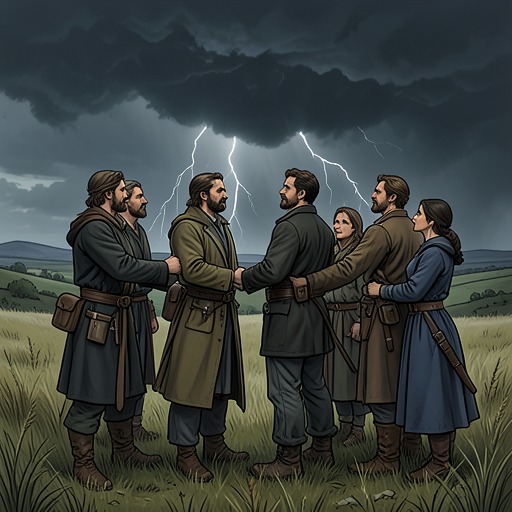
Hearthstone also exposes the structure of Alethi authority through the arrival of its new citylord. Lirin hurries Kaladin and the rest of the household to hear the new ruler’s first speech, identifying him as Brightlord Roshone and warning that there is no time to change clothes. Roshone has sent no word ahead, and his unexpected arrival disrupts the town’s ordinary rhythm before he has even spoken.
Kaladin’s response reveals the attraction of the hierarchy as well as its danger. His worries are briefly displaced by the opportunity to meet a new lighteyes. He is drawn to the possibility of honor and travel, and he can imagine war as a route into a larger life. The prospect that finding a Shardblade could make him a lighteyes gives the social order a seductive promise: Hearthstone’s boundaries might be escaped, but only through the very system that ranks people by eye color and inherited power.
Roshone’s entrance therefore changes the meaning of the town. Before his arrival, Hearthstone is chiefly a family and medical environment, governed by custom and practical necessity. With the new citylord comes a sharper awareness that the town is also subject to distant political authority. The speech is a public event, but its effect begins privately, in Kaladin’s sudden fascination with the visitor and in the family’s hurried effort to present itself properly before him.
Narrative Significance
Hearthstone functions as the starting point against which Kaladin’s later transformations can be measured. Its operating room teaches him that life can depend on discipline, competent hands, and reliable light; its inherited occupations teach him how easily duty becomes destiny; and Roshone’s arrival teaches him that social power can enter a small community without warning. These pressures do not produce a single simple rejection. Kaladin both understands the value of his father’s work and longs for the movement, honor, and danger associated with war.
The town’s narrative importance lies in this tension between care and confinement. Hearthstone contains the first evidence of Kaladin’s instinct to protect the wounded, but it also represents the settled future others have prepared for him. Its borrowed broams, improvised bandage, shuttered windows, and formal citylord’s speech place private compassion beside public hierarchy. When Kaladin begins looking beyond Hearthstone, he is not merely abandoning home; he is carrying its medical ethic and its unresolved question of whether a life should be inherited or chosen.